
In brief
Contract terms change after signing, differ across vendors and decide much of what a company pays, yet most companies keep them only as documents. This paper explains how version drift, the gap between the terms in force and the terms people work from, leads to overpayments and disputed supplier claims, why the cost of checking keeps those losses hidden, and how to audit a vendor portfolio for outdated terms.
Contracts are a data source most companies leave untouched
A contract is usually treated as a document. It is negotiated and signed, then filed and reopened when something goes wrong. That treatment misses what a contract portfolio actually is. Its terms change through amendments and renewals and differ from vendor to vendor, and together they govern a large share of company spending. Taken as a whole, the portfolio is a dataset, and in most companies it is one that nobody maintains with the discipline applied to sales or supply chain data.
Supplier claims show the cost of this clearly. Large consumer goods companies receive a steady flow of claims from suppliers and service providers asserting that money is owed, and each claim has to be validated against the agreement in force at the time, usually within a fixed response period.
A typical case starts with an amendment signed partway through the year to change a rate or remove a fee. The vendor's billing team keeps working from the original agreement. The company pays on the amended terms, the vendor records a shortfall, and a claim for the difference arrives months later. The error also runs the other way, when a payment is made on terms that have already been replaced and the difference has to be recovered. Bad faith is seldom involved. The two parties are working from different versions of the same agreement.
Version drift is the gap between the terms in force and the terms people work from.
The expensive step, for analysts and for software alike, is establishing which terms applied on a given date. The answer exists, scattered across shared folders, email threads and amendments that refer to earlier amendments. At its core that is a data problem, and the rest of this paper treats it as one, with a qualification covered later: some of these questions also need legal judgment.
Why supplier claims get paid without a check
A large company can receive thousands of claims a year, many for small amounts. Agreements commonly set a response window: once a claim arrives, the company must pay or communicate its decision within a fixed period, and missing it can trigger a penalty. Validating a claim means locating the right contract, the right amendment and the terms in force on the relevant date, all inside that window. For a small claim, validating in time can cost more than the claim is worth, so companies commonly set a threshold below which claims are paid without full review.
The threshold follows from simple arithmetic. Checking claims is worth doing when the share of invalid claims is higher than the cost of a check divided by the average claim value. In the version drift case described above, the claim is itself the gap created by an outdated rate, so when it is invalid, the whole amount is unowed.
Take an average claim of $250. If a manual check costs $25 in analyst time, checking pays for itself only when more than 10% of claims are invalid. If the same check costs $5, the break-even point drops to 2%. For a company paying 10,000 such claims a year, $2.5 million in total, a 2% invalid rate means $50,000 a year paid that was never owed. These figures are illustrative. The same calculation with real claim values and real checking costs shows where a threshold should sit.
The threshold is therefore better understood as a cost-of-validation problem than as a policy choice. It sits where it does because checking is slow, and much of that time goes into finding the current terms. With each vendor's current terms recorded alongside the date they took effect, the cost of a check falls, and the threshold falls with it.
Small differences on vendor invoices go unchallenged for the same reason. Where overpayments are found, recovery is not automatic either. It depends on the audit rights, recoupment clauses and time limits in each agreement, which is one more reason to catch errors before payment rather than after.
Three kinds of problem in a contract portfolio
Contract data goes wrong in three ways. The first two can be fixed with discipline and comparison. The third is the larger opportunity that opens up once the first two are under control.
Version drift
Contracts keep changing after signature. Amendments, renewals, side letters and change orders each supersede part of the original, yet the original typically stays in the same folder and still looks authoritative. Whoever opens it, on either side, can end up applying terms that have lapsed. This is a contract version control problem, and contract amendments rarely receive the version discipline that code or financial data does. The remedy is an effective-dated record: each amendment compared with the version it replaced, and the changed terms recorded with the date they took effect.
Drift from the standard
Each vendor contract is negotiated on its own. One vendor secures longer payment terms, another a lower liability cap, a third a renewal clause with a short notice window. Each concession was defensible when it was made. Across hundreds of contracts, the company's real commitments move well away from its standard terms, often set out in a gold standard contract or contract playbook, and the size of that gap is seldom known. A simple question such as which vendors can raise prices at renewal without a cap is rarely answered quickly. The remedy is to measure every contract against the standard, term by term, so the gaps are known and can be prioritized.
Terms disconnected from results
Once terms exist as data, they can be set against outcomes. In consumer goods, trade agreements with retailers set the funding for each promotion and are revised during the year, and tracking how those terms vary against the sales that followed is a natural input to revenue management. In procurement, the same applies to volume discounts and rebate tiers. Where terms are instead re-keyed by hand into finance systems, a missed amendment feeds wrong figures into every analysis built on them.
Where contract management systems stop short
Contract lifecycle management (CLM) systems address part of this. Modern platforms handle drafting, approvals, signatures and storage well, and many extract key terms from documents.
Gaps remain common in practice. Not every company has a CLM system, particularly in the mid-market, and contracts often sit in shared drives and inboxes. Where a system exists, older agreements are often never loaded into it, and key terms tend to be captured once, at signing. An amendment signed two years later can end up stored beside the original while the recorded terms stay unchanged. The system then holds the right documents without a reliable answer to which terms apply today.
CLM is the foundation. Terms held as effective-dated data, reconciled against payments and analyzed across the portfolio, form the layer above it.
Where data ends and legal judgment begins
Which terms apply is not always a simple lookup. Order-of-precedence clauses, whether an amendment was properly executed, side letters and the way the parties have actually behaved can all affect the answer. Those are questions of interpretation, and they belong with legal counsel. Data does not replace that judgment. It brings the questions that need it to the surface early, and turns a search through folders into a short list of specific clauses for counsel to review.
Treating contract terms as data
Contracts call for the same first step as any other business data problem, which is establishing what data exists and in what form.
The starting point is a baseline. The company's standard terms serve as the reference, and each contract is described by how it departs from that reference, term by term, instead of as a long document to be read again.
Each term then needs a history: its value, its effective date and its source document. With that history in place, finding the terms in force on a given date becomes a lookup.
A second date matters too, and data practitioners will recognize the result as a bitemporal problem. One date records when a term applied. The other records when the company learned of it. An amendment signed in March may take effect from January and reach accounts payable only in May. Claim disputes turn on both dates: the terms in force on the invoice date, and what the company knew when it paid. A record that holds both dates answers both questions and explains, after the fact, why a payment was made as it was.
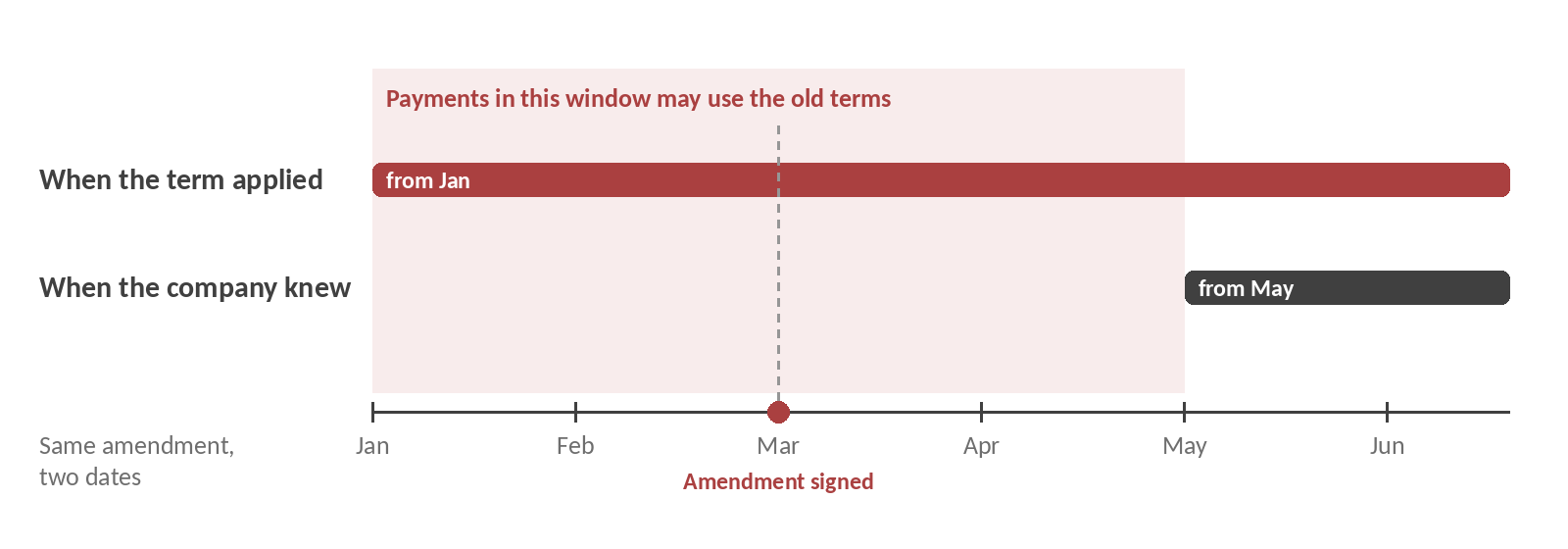
With terms recorded consistently, the whole portfolio becomes queryable. It is then straightforward to see what share of spend sits with vendors whose liability cap falls below the standard, or which agreements renew in the next 90 days on terms the company would no longer accept.
The largest financial return comes from joining contract terms to invoices, claims and spend, because that join produces a specific list of payments to review.
None of these techniques is new to analytics. The hard part is the first step: establishing accurately what each contract says and which version applies. Many attempts stall there.
How to audit vendor contracts for outdated terms
A spreadsheet and one to two weeks of work will show whether version drift is costing a company money.
- Take the 20 largest vendors by spend and add every agreement amended in the last 18 months. Amended agreements are where version drift concentrates.
- Select the five or six terms that matter most, such as payment days, price increase rights, renewal notice, liability cap and any discount or rebate tiers.
- For each amended agreement, compare every amendment with the version it replaced and note which terms changed and from what date.
- Record the current value of each term for each contract, with its effective date and source document.
- Compare each value against your standard terms and mark the differences.
- For the amended agreements, test a sample of recent invoices or claims against the recorded terms.
A clean sample confirms that current terms are being applied correctly. Payments made on outdated terms give a first estimate of the cost and show where to look next.
The long version of this paper adds a worked example portfolio, a method for deciding which contracts to review first, and a drift audit worksheet. It is sent by email on request.
Where Clauselytics fits
The first two problems are, at root, comparison problems. Version drift asks what each amendment changed relative to the version before it. Drift from the standard asks how each contract differs from the company's standard. Steps 3 and 5 of the audit are where most of the manual effort goes, because they require reading each amendment against its predecessor and each contract against the standard, clause by clause. The steps that follow, recording dates and joining terms to invoices, use tools a finance team already has.
Clauselytics does that comparison. It sets a contract against a benchmark, which can be the previous version of the same agreement or the company's gold standard contract, and produces a gap report in which every difference is rated by risk and cited to the exact clause. Run across an agreement and its amendments in order, the reports show at each step which clauses changed and how significant each change is. That record is the raw material for the term history described in this paper.
Holding that history in a finance or analytics system, and joining it to invoices and claims, remains work for the company's own data and finance teams.
Contracts are confidential, and Clauselytics never collects them through web forms. How documents are handled is set out on the security page.
For a vendor MSA or SaaS agreement and its amendments, request a review.
AI tools were used to help structure and edit this paper. The examples, views and conclusions are the author's own, and every statement has been checked. The claims figures are illustrative, not data from any company. This paper is general information, not legal advice.